Signs a Student Is Struggling in School
By Diane Dunlop CFDE – Blog
Now there is a different kind of silence in a classroom.
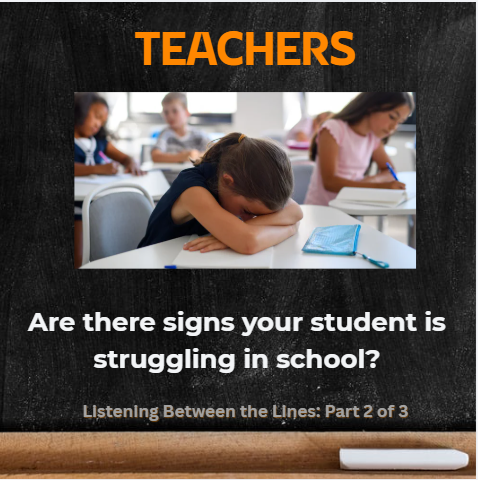
Not the silence of depth learning — but the quieter, heavier kind. That student who used to raise their hand but now avoids eye contact. The one who stares at the page but doesn’t turn it. The one who disrupts because sitting still is impossible. These may be subtle signs a student is struggling in school, long before report cards reflect what is really happening.
In our first Listening Between the Lines article, we educated parents about the quiet signs that show up at home. This time, we step into the classroom — where teachers often notice the same shifts unfolding in different ways.
Teachers often see what others cannot. They see patterns. Shifts. Changes in tone. Changes in energy. And while grades matter, connection often matters more.
This is not about adding more responsibility to already full plates. It is about recognizing that teachers are often the first to notice when something feels “off.”
Why the Signs a Student Is Struggling in School Matter
Across Alberta, student wellbeing has become an increasing focus in conversations about education. Emotional regulation, anxiety, social disconnection, and academic pressure are not abstract issues — they show up daily in classrooms.
The province has invested in school-based mental health supports to help students build resilience and cope with stress, emotional regulation, and social pressures.
A recent survey by Healthy Living Alberta, found that 68 % of Alberta students report anxiety about academic performance and future prospects, illustrating how emotional strain and academic pressure are regular parts of many students’ school experiences.
National youth mental health data also shows that the number of young people reporting “fair” or “poor” mental health has more than doubled in recent years — a trend that reflects increasing wellbeing challenges among students.
When we talk about the signs a student is struggling in school, we are not just talking about falling grades. We are talking about shifts in behaviour, engagement, mood, and participation.
Sometimes those signs are quiet.
Sometimes they are disruptive.
Sometimes they might even be missing.
Recognizing the signs a student is struggling in school early can change the shape of a young person’s experience — not just academically, but emotionally.
The Quiet Student
One of the most overlooked signs a student is struggling in school is withdrawal.
That student who:
- Stops volunteering answers
- Avoids group work
- Keeps their head down
- Submits work late or not at all
This student may not cause concern immediately. They are not loud. They are not defiant. They are not demanding attention.
But silence can be a signal.
A quiet shift in participation may reflect anxiety, social stress, confusion about material, or something happening beyond the classroom walls. It may be one of the early signs a student is struggling in school, even if behaviour remains compliant.
A gentle check-in — “I’ve noticed you’ve been quieter lately. How are things going?” — can open doors that grading policies cannot.
The Disruptive Student
Sometimes the signs a student is struggling in school look very different from silence..
Instead of withdrawal, there is restlessness. Instead of silence, there is interruption.
This student may:
- Talk out of turn
- Challenge authority
- Struggle to stay seated
- React strongly to being corrected
It is easy to label this behaviour as defiance. But behaviour is communication.
Disruption can be a form of overwhelm.
Frustration can hint at confusion.
Anger can hide shame.
When a student would rather be sent out of the room than risk appearing incapable, that is not a discipline issue first — it is a vulnerability issue.
Seeing the behaviour as one of the signs a student is struggling in school shifts the response from punishment to curiosity.
The High Achiever Who Is Quietly Burning Out
Not all signs a student is struggling in school appear in low grades.
Some students continue to perform — even excel — while carrying immense internal pressure.
These students may:
- Panic over minor mistakes
- Obsess over perfection
- Stay late repeatedly
- Express fear of disappointing adults
On the surface, everything looks fine. But underneath, anxiety may be driving performance.
Burnout does not always show up as failure. Sometimes it shows up as overdrive.
Recognizing that perfectionism and chronic stress can also be signs a student is struggling in school allows educators to support students who might otherwise be overlooked.
When Devices Become a Shield
In today’s classrooms, another emerging pattern among the signs a student is struggling in school is device dependency.
A student may:
- Retreat into their phone during transitions
- Avoid eye contact while scrolling
- Use technology as a barrier during peer interaction
Technology itself is not the issue. Often, it is a coping tool.
For a student navigating social anxiety, academic stress, or emotional overload, a device can provide momentary control and distraction.
Rather than immediately confiscating or escalating, noticing when and why device use increases can provide insight. It may be one of the quieter signs a student is struggling in school, especially when paired with other behavioural shifts.
Small Interventions Matter
Let’s be clear, educators are not therapists. They are not expected to solve every problem. But they are often positioned to notice the signs a student is struggling in school before anyone else.
And small interventions matter.
A private conversation after class.
A note sent home that’s framed with care, not concern alone.
A referral to school support staff.
A needed conversation with parents or guardians.
These moments create safety.
When teachers and parents communicate early, patterns become clearer. Parents may see changes at home. Teachers may see changes in class. Together, those observations can form a fuller picture of the signs a student is struggling in school and what kind of support might help.
Partnership Between School and Home
The signs a student is struggling in school rarely exist in isolation.
Parents may notice the silence at dinner.
Teachers may notice the silence during lessons.
When those two perspectives connect, support becomes stronger and more consistent.
A simple message that says, “I’ve noticed a shift and wanted to check in,” can prevent small struggles from growing into larger ones.
Community wide, supporting student wellbeing requires more than awareness — it requires collaboration.
Collaboration reduces stigma. It sends a powerful message to the student: the adults in your life are working together, not working against you.
Community organizations like CFDE work alongside families and schools to provide structured academic and social supports that help students rebuild confidence and connection.
Through programs such as Homework Club, STEM and creative enrichment activities, mentorship, and learning supports, CFDE creates spaces where youth can strengthen problem-solving skills, develop resilience, and feel supported both inside and outside the classroom. When educators recognize the signs a student is struggling in school, partnerships with community-based programs can turn concern into meaningful, practical support.
Listening Between the Lines
Ultimately, recognizing the signs a student is struggling in school is about listening beyond surface behaviour.
It is about asking:
- What might this behaviour be communicating?
- What changed recently?
- What support might help?
Every classroom carries stories that are not written in textbooks.
Educators carry more than curriculum. They carry the daily responsibility of noticing — and sometimes, that noticing is what makes the greatest difference.
Not every struggle will be visible.
Not every concern will be urgent.
But early awareness builds trust.
And sometimes, listening between the lines in a classroom is the first step toward helping a student feel seen, supported, and capable again.